
In short: Since 1 June 2024, mobile and tower cranes in Malaysia need a DOSH certificate of fitness, valid for 15 months, and must be run by a registered competent crane operator under a lifting plan. Check the certificate, the operator's registration and who prepares the lifting plan before you hire, then compare quotes on the same lift details.
Johor is one of the busiest lifting markets in the region. Cushman & Wakefield’s Asia Pacific data centre update for the first half of 2026 put Johor at 1,110MW of operational data centre capacity, 602MW under construction and 2,486MW planned, with 1,039MW under construction across Malaysia, EdgeProp reported on 27 August 2026. Knight Frank’s Data Centre Atlas 2026 counts a Johor pipeline of 8,542MW and a colocation vacancy rate of 0.7%, according to the New Straits Times on 31 August 2026. The two firms measure differently, so the figures do not add up to each other, but both point to a lot of steel, precast and heavy plant going up.
Factories are adding to that. The Johor-Singapore Special Economic Zone (JS-SEZ) recorded RM76.98 billion of approved investments in 2025 and RM5.49 billion in the first quarter of 2026, with 57% of cumulative approved investments at the implementation stage, Bernama reported via the NST on 2 July 2026. On the infrastructure side, Malaysia and Singapore decided to start Johor Bahru-Singapore RTS Link operations in February 2027, according to Bernama on 8 October 2026.
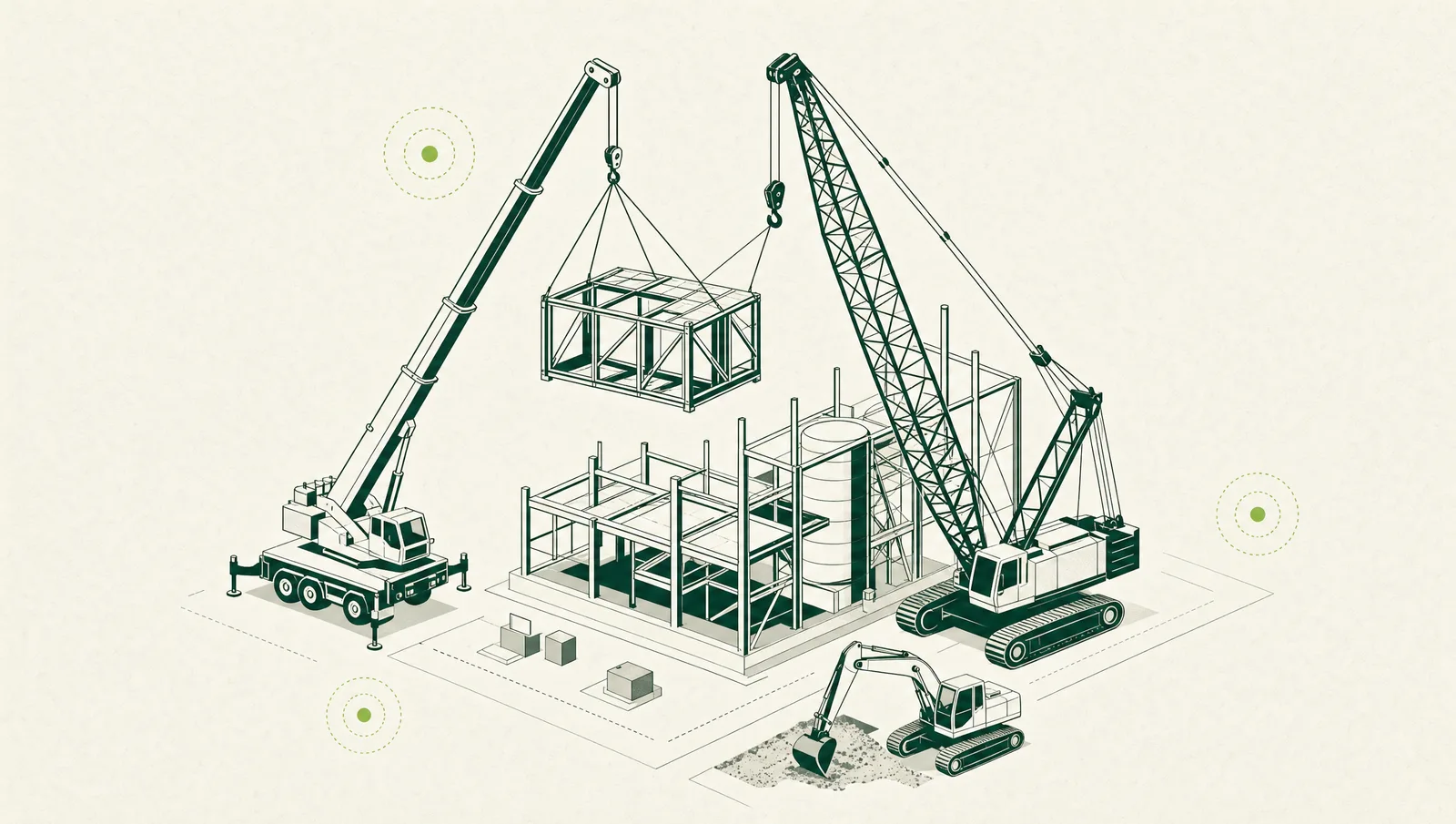
Each of these projects needs cranes, from tower cranes on building sites to large mobile and crawler cranes for generators, chillers and transformers. FYAdvisers is a technology consultancy and lead generation firm based in Singapore that now serves Malaysia. It does not own or operate cranes. We help you define the lift and introduce rental providers who do the work.
The rules every crane hire must meet
Certificate of fitness
On 1 June 2024 the Occupational Safety and Health (Plant Requiring Certificate of Fitness) Regulations 2024 (P.U. (A) 99/2024) came into operation. DOSH’s lifting machinery design page says all power-driven lifting machinery must obtain design verification and a valid certificate of fitness from DOSH before construction, installation or use.
Key points from the regulations:
- A certificate of fitness is valid for 15 months from the date of inspection (regulation 5(6)).
- Tower cranes must have a comprehensive examination by a competent person at least once every three months, or more often if the manufacturer’s manual says so (regulation 14). An owner or occupier who fails to do this faces a fine of up to RM100,000, up to one year in jail, or both.
- An owner who sells, leases, transfers or disposes of certified plant must notify the officer or licensed person within 30 days (regulation 5(5)).
- The Third Schedule excludes some equipment, such as material handling equipment (forklifts, excavators, dumpers), drilling rigs, piling rigs for permanent foundations and winches installed on vehicles.
Competent crane operators and a lifting plan
Regulation 15 is the one buyers should read closely. The owner or occupier must ensure each tower crane or mobile crane is operated only by a competent person who is a crane operator, and must establish a lifting plan based on the risk assessment. The operator must test limit switches and indicators without load before lifting, record the results before each shift, and report ground conditions that look unsafe.
DOSH registers crane operators as competent persons. Its crane operator page says the competency certificate is valid for two years and that applicants must have attended a recognised crane operator course.
CIDB
CIDB’s contractor registration page says contractors must register before carrying out construction work in Malaysia, unless exempted, with fines of RM10,000 to RM100,000 for a breach. Site personnel must also be registered with CIDB: CIDB’s chief executive told Bernama on 4 December 2025 that registration in the CIMS system is mandatory, while the new physical card is voluntary for now. See our CIDB registration guide for grades and categories.
Moving the crane on public roads
Large mobile cranes and crane components may count as oversized loads on Malaysian roads. We have not verified the current permit process and issuing agency, so ask each provider who obtains road movement approvals and escorts, and whether the cost is in the quote.
Choosing the right crane
| Crane type | Typical use | Points to check |
|---|---|---|
| Mobile crane (all-terrain or rough-terrain) | Short-term lifts, M&E equipment, steel | CF, outrigger loads, ground bearing |
| Crawler crane | Heavy or repeated lifts over weeks or months | Transport, assembly space, ground preparation |
| Tower crane | Multi-storey buildings and long programmes | Design verification, erection crew, three-monthly examination |
| Lorry crane (lorry loader) | Deliveries and light lifts | CF status for the crane, operator competency |
Wet hire or dry hire
- Wet hire. The crane comes with the provider’s operator, usually with fuel and basic support. This is simpler for most one-off lifts.
- Dry hire. You rent the machine only and supply a registered crane operator yourself. Under regulation 15, you still need a lifting plan and a competent operator.
What to specify when you ask for quotes
- Heaviest load, its dimensions and lifting points
- Lift radius and height, and where the crane can stand
- Ground conditions and any underground services
- Site address, access route, gate width and working hours
- Number of lifts and the hire period
- Wet or dry hire, and whether you need riggers and signallers
- Who prepares the lifting plan and risk assessment
How pricing is usually scoped
We have not found a published Malaysian crane rental price list we could verify, so we do not quote figures. Quotes usually depend on:
- Crane type and capacity. Larger cranes cost more per day and to move.
- Hire period. Hourly, daily, weekly or monthly rates.
- Wet or dry hire. Operator, fuel and support crew.
- Mobilisation. Distance to site, counterweight transport and assembly.
- Permits and escorts. For oversized road moves.
- Engineering. Lifting plans, ground assessments and supervision for complex lifts.
Owners also pay DOSH statutory fees. The Sixth Schedule of the 2024 Regulations sets inspection fees for mobile cranes from RM550 (safe working load under 25,000kg) to RM1,000 (250,000kg and above), and RM1,300 for tower cranes.
Red flags
- A crane without a current certificate of fitness, or a copy for a different unit
- An operator who cannot show competent person registration for that crane type
- No lifting plan, or “we will decide on the day”
- A tower crane with no record of three-monthly examinations
- Logbooks with no pre-shift limit switch tests
- A price that leaves out mobilisation, permits or rigging crew
Buyer checklist
- Can we see the CF for the exact crane you will send?
- Who is the operator, and what is their DOSH registration?
- Who prepares the lifting plan, and can we review it?
- Are riggers and signallers included and CIDB-registered?
- Who handles road movement approvals?
- What happens if wind or ground conditions stop the lift?
- What insurance cover does the provider hold for the crane and the lift? Ask for the certificate.
For suppliers: what buyers will ask you for
Data centre and JS-SEZ projects are usually run by large developers and main contractors with formal pre-qualification. Expect to be asked for the following before a site visit.
Fleet details
Buyers want a fleet list showing crane type, capacity, year and current location, so they can see whether you can supply the crane they need and a back-up if one fails. Include support equipment: low-loaders, aerial working platforms and tested rigging gear.
Certificates per unit
Have a current CF for each crane ready, and track expiry dates against the 15-month validity. For tower cranes, buyers will also check design verification and three-monthly comprehensive examination reports.
People
Buyers check each operator’s DOSH competent person registration and its expiry, plus CIDB personnel registration for everyone working on site. If you erect, dismantle or maintain tower cranes, they may ask for your Competent Person (Company) registration under section 31B.
Planning and safety systems
Show sample lifting plans, risk assessments and method statements. ISO 45001 certification helps with pre-qualification at larger firms but does not replace the legal requirements above.
Commercial documents
Expect requests for your CIDB registration if crane work is part of the site scope, insurance certificates, company registration and a clear rate card for wet and dry hire.
How FYAdvisers matching works
- Describe your need. Tell us what needs lifting, where and when.
- Free concierge consultation. A concierge contacts you to confirm the lift, site and timing.
- We introduce one to five providers. With your consent, we introduce you to the number of crane rental providers you choose, up to five.
- Meet and decide. Providers reach out directly with questions and quotes. You choose whether to work with any of them.
Matching is free for you. Providers pay FYAdvisers to receive introductions. FYAdvisers does not own, operate or rent out cranes, and we only share your details with your consent.
For suppliers
Supplying cranes to data centre, factory or infrastructure projects in Johor?
Apply to receive requests if you rent out mobile, crawler, tower or lorry cranes with operators or on dry hire in Malaysia. Buyers will check each crane's DOSH certificate of fitness, your operators' competent person registration and how you plan lifts before they ask for a price.
Who is buying
- Data centre developers and their main contractors in Johor
- Factory and warehouse builders in the Johor-Singapore Special Economic Zone
- Mechanical and electrical contractors lifting generators, chillers and transformers
- Rail, road and utility contractors
- Steel and precast erectors
- Plant owners needing shutdown or equipment replacement lifts
What buyers expect you to have
- Mobile cranes, all-terrain and rough-terrain, across a range of capacities
- Crawler cranes for heavy or long-duration lifts
- Tower cranes with erection, climbing and dismantling crews
- Lorry cranes (lorry loaders) for deliveries and light lifts
- Aerial working platforms, boom and scissor lifts
- Rigging gear such as slings, shackles and spreader beams with test records
- Low-loaders and trailers to move cranes, counterweights and components
- Working limit switches, load indicators and logbooks on every crane
Registrations and certifications buyers check
| Certification | Issued by | Why it matters |
|---|---|---|
| Certificate of fitness (CF) for each crane | DOSH (JKKP) | Required for mobile and tower cranes under the OSH (Plant Requiring Certificate of Fitness) Regulations 2024 and valid for 15 months from inspection; buyers ask for a copy for every unit on the quote. |
| Competent person registration as crane operator | DOSH (JKKP) | Regulation 15 requires every tower and mobile crane to be operated only by a competent person who is a crane operator; buyers check the operator's registration for the crane type. |
| Competent Person (Company) registration | DOSH (JKKP) | Section 31B of the OSH Act 1994 restricts work such as installation, erection, dismantling, maintenance and inspection of certified plant to registered companies; relevant for tower crane erection and maintenance. |
| CIDB contractor registration (PPK) | CIDB Malaysia | Contractors must register with CIDB before carrying out construction work in Malaysia; main contractors often ask for it when crane work forms part of the site scope. |
| CIDB construction personnel registration | CIDB Malaysia | Site personnel must be registered with CIDB through the CIMS system; main contractors check this for operators, riggers and signallers working on site. |
| ISO 45001 certification | ISO standard, certified by an accredited certification body | An occupational health and safety management system standard that larger developers and main contractors often ask for when pre-qualifying subcontractors. |
Frequently asked questions
How does matching work?
You describe what needs lifting, such as generators, chillers, steel, precast panels or a tower crane for a building, plus the site, dates and whether you want the crane with an operator. A concierge then contacts you to confirm the details and, with your consent, introduces you to the number you choose (one to five) of crane and machinery rental providers that handle that kind of work. They contact you directly, and you decide whether to go ahead with any of them.
Is it free?
Yes. It is free for businesses requesting a match. Providers pay FYAdvisers to receive introductions. FYAdvisers is a technology consultancy and lead generation firm, not a crane company, and does not own, operate or rent out cranes itself.
Does a rented crane need a certificate of fitness in Malaysia?
Yes, for mobile and tower cranes. The OSH (Plant Requiring Certificate of Fitness) Regulations 2024, in force from 1 June 2024, treat lifting machinery as plant requiring a certificate of fitness. A certificate is valid for 15 months from the date of inspection. Some equipment is excluded in the Third Schedule, including material handling equipment such as forklifts and excavators, and winches installed on vehicles.
Who can operate a mobile or tower crane?
Regulation 15 of the 2024 Regulations says the owner or occupier must ensure each tower crane or mobile crane is operated only by a competent person who is a crane operator. DOSH registers crane operators as competent persons, and its crane operator page says the competency certificate is valid for two years.
What is the difference between wet hire and dry hire?
Wet hire means the crane comes with the provider's operator and usually fuel and basic support. Dry hire means you rent the machine only and supply your own registered operator, so more of the legal duties and the lifting plan sit with you.
How much does crane rental cost in Malaysia?
We have not found a published Malaysian crane rental price list we could verify. Quotes depend on crane type and capacity, hire period, wet or dry hire, mobilisation distance, rigging crew and any road or site permits. DOSH's own inspection fees for mobile cranes range from RM550 to RM1,000 depending on safe working load, which owners usually build into their rates.